


Frequently Asked Questions
Our House is the new Chartist movement for people-powered democracy.
We are a community-led movement supported by a small team of participatory democracy practitioners, community organisers and storytellers working to transform politics — drawing on an 800-year tradition, from the Magna Carta to Charter 88, of transferring power from where it is concentrated, towards the people.
A People’s Charter is a set of demands and actions for how power and democracy should work, developed locally, connected nationally. These charters feed into a four-nation movement for political systems change, and as a blueprint for how to decide better together locally.
The chartists of the 1800s made 6 demands that took power from the aristocrats and distributed it to the people through ideas such as votes for all men and constituencies of equal size. People’s Charters are focused on democracy and decision-making, not policy. This means in a time of polarisation, we can put down the issues that divide us, and build a democracy that can bring us together to solve all of our problems.
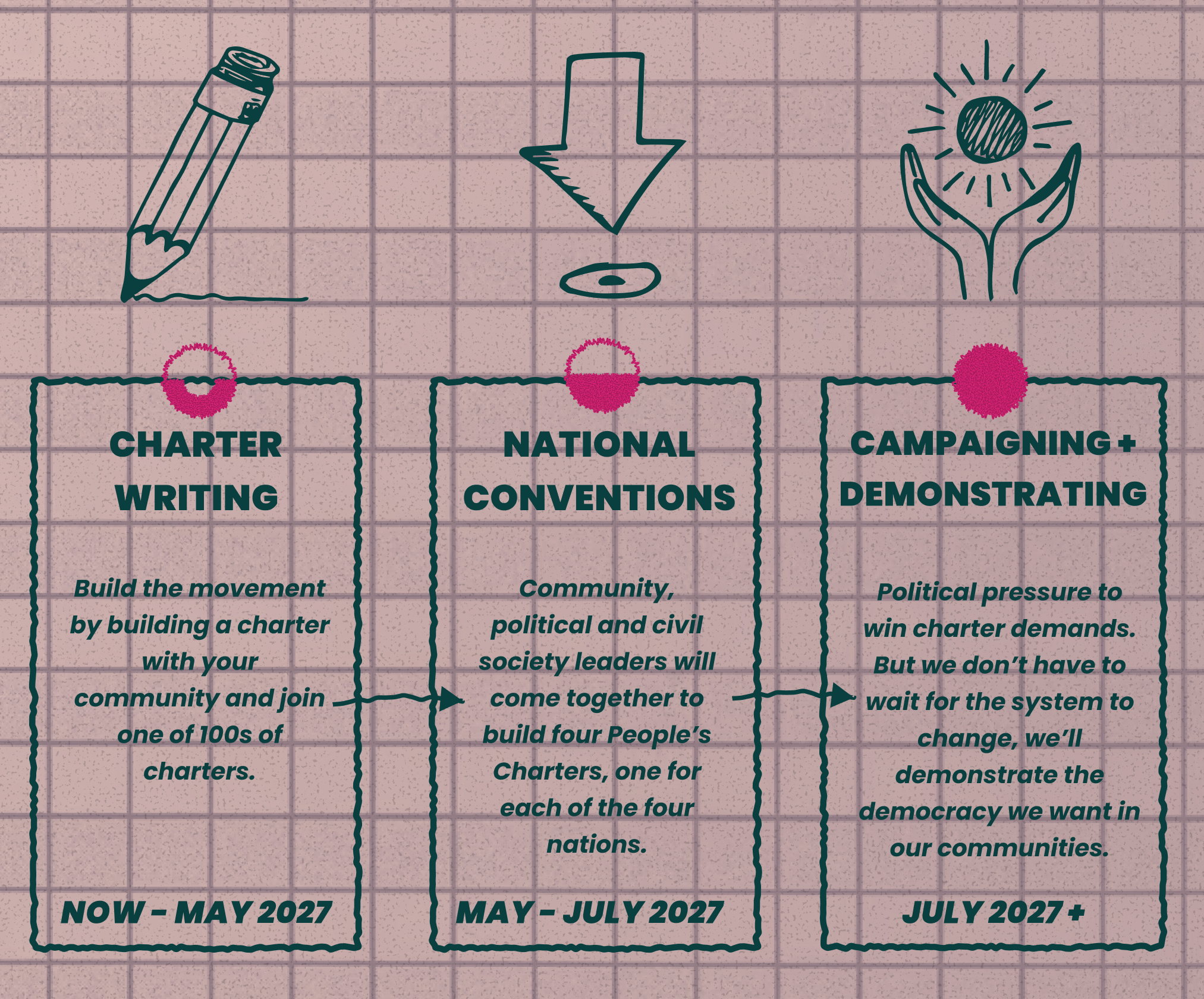
You can build your local People’s Charter between now and May 2027, when we convene community, political and civil society leaders for the four National Conventions in the summer of 2027. All the People’s Charter groups will send delegates to craft a People’s Charter for each of the Four Nations of the UK. Political leaders will champion the charter demands in their party conferences in September 2027, and we will continue campaigning and advocating for the demands up until the next UK-wide general election.
But we don’t have to wait for the political system to change; our active group of chartist organisers can bring to life People’s Charters in their community through new ways of organising and deciding together.
You can build a charter! You don’t need much to start. We’ve created a nifty game to start the conversation and introduce new ideas that might inspire you to reimagine who has power and how it might work in the future. Building a charter is the first step. Once you’ve drafted an initial set of demands, you can build on them and finalise them by bringing more people into the conversation. We’ve seen this strengthen the bonds and build bridges between divided ideologies. We might not agree on everything, but we all agree power is too far from the people.
Find out other ways to get involved by visiting our Get Involved page. You can either start a new charter group or join one locally. If you want to facilitate charter building, then reach out at hello@ourhouseuk.org to join our Facilitator Network. Find out about all of this and more at a monthly community call to learn more!
Anyone from across the Four Nations of the UK can get involved, from sports clubs to church groups to community organisations to politicians. You can get started by writing a charter with your community, from 6 to 500 people. All you need is you, your imagination, a core belief that a better world is possible, and a group of people that you can organise with!
Organisations may find it easier to bring people together to build a charter, but if you’re an individual, we would love to see you get your own group together and build! You can also advocate for a People’s Charter, or join the facilitator network to lend your facilitation skills to charter-building efforts near you.
At the moment, yes. However, if you’re based elsewhere, please get in touch at hello@ourhouseuk.org, and we’d be happy to support your own effort in whatever way we can.
“Democracies don’t survive when they stagnate… The history of democracy is a history of constant struggle, evolution and change.” Oliver Escobar, Professor and author
Changing and evolving democracy is the bedrock of the practice. We’re living in a stagnant system that no longer meets the needs and hears the emotions of the people. If the Chartists of the 1800s could win people power from aristocratic rule, then so can we. It won’t be easy, and it won’t happen overnight – but it is possible and necessary. Our society has evolved in a myriad of ways, from how we get around, to how we connect with other humans – and in all that time, we have not changed how we participate in our democracy!
But there are windows of hope. There are now 10s of groups across the four nations imagining what we could change in democracy to build a fairer, more equal and safer society. There is growing support for proportional representation, and in England, the English Devolution and Community Empowerment Act lays the groundwork for neighbourhood governance. So now is the time to start imagining how democracy will evolve as it is transferred out of Westminster.
Our House is made up of a small part-time team and a network of volunteer organisers across the four nations. We’re a group of people who believe democracy’s survival depends on its reimagination, and that as many people as possible should get involved to build something that works. Check out our team page to learn more about our core team and board members.
Our House’s core funding is from Esmée Fairbairn Foundation, as well as grants from Polden Puckham Charitable Foundation, Coral Foundation, and the Joseph Rowntree Collective Imagination Fund. We have also received generous donations from a small number of individuals. If you have the means and are willing to support our team with movement building to cover travel, accommodation, organising and infrastructure costs - please consider donating!
The original chartists of the 1800s faced challenges very similar to our own. Industrialisation had rapidly changed the shape of the country. The air was thick with soot, the cost of rent rose rapidly, bread doubled in price, and wages went down. People couldn’t afford to heat their homes and were hungry and angry. What’s stark is that politicians at the time praised the rate of “progress”, and celebrated the “new era” they lived in. However, they were completely out of touch with the diminishing quality of life the people were experiencing.
The chartists formed because they saw people campaigning on individual issues - labour standards, healthcare access. They realised the root cause of all of these issues was power - who had power, and how it worked.
We’re living through a similar crisis – and if we don’t also tackle the problem at the root, we risk losing all our campaigns on the many issues facing us at once.
Our House doesn’t need to be your sole focus, or the only thing you campaign on and advocate for - but no matter what, power should always be a part of the conversation, and actively trying to come up with new solutions for distributing it should become a core part of your practice.